Choosing a Puppy Is More Than Falling in Love With a Cute Face
One of the first questions I hear after announcing a planned litter is, “When do I get to pick my puppy?” It’s an exciting question, and I completely understand why families ask it. After all, you’ve been waiting for the breeding to take place, following the pregnancy, and watching the puppies grow through photos and videos. It’s only natural to start imagining which one will eventually come home with you.
Many people assume choosing a puppy is as simple as visiting the litter, seeing which puppy walks over first, or picking the one with the markings they like best. While those moments are certainly enjoyable, they don’t tell the whole story. A few minutes with a litter can’t reveal what I’ve been observing every day since those puppies were born.
As a preservation breeder, my responsibility goes far beyond raising healthy puppies. My job is to evaluate each puppy as an individual, understand how that puppy is developing, and then carefully match each one with the family where it is most likely to thrive. That process takes time, patience, and experience. It isn’t something that can be rushed during a single visit or determined by a photograph.
The goal isn’t simply to help you choose a puppy. The goal is to help you welcome the right puppy into your family—one whose temperament, confidence, activity level, and personality are a good fit for your lifestyle. When those pieces come together, everyone benefits: the puppy, the family, and ultimately the breed itself.
I Breed for Myself First—And That’s a Good Thing
When I tell people that I breed for myself first, I sometimes get a surprised look. It can sound as though I’m saying puppy buyers come second, but that’s not what I mean at all.
What I mean is that every litter I plan is first and foremost an attempt to preserve and improve the French Bulldog. I don’t breed simply because I want puppies to sell. I breed because I have spent months—sometimes years—planning a specific breeding in the hope of producing the next generation of TerraSassa.
Every breeding is carefully considered. I look at pedigrees, temperament, structure, movement, and how each sire and dam complement one another. My goal is always to produce healthy, sound French Bulldogs that meet the breed standard and have the stable temperaments that make them wonderful companions.
When the puppies are born, I don’t know if there will be one that I want to keep for my breeding program. Sometimes there is, and sometimes there isn’t. That’s a decision that simply can’t be made when the puppies are only a few weeks old.
The puppy that eventually stays at TerraSassa isn’t necessarily the flashiest puppy or the one with the most eye-catching markings. I’m looking much deeper than that. I’m evaluating how each puppy develops over time, and those evaluations continue for weeks as the puppies mature.
Only after I’ve had the opportunity to complete those evaluations can I begin making final placement decisions. The puppies I place with their new families aren’t the ones I “didn’t want.” They are puppies I have come to know well and can confidently match with the families that are the best fit for them.
A Few Minutes Doesn’t Tell the Whole Story
One of the most common things I hear when families come to visit is, “That puppy picked me!” Usually, it’s because one puppy walked over, climbed into their lap, or eagerly accepted attention.
Those moments are wonderful, and I love seeing that excitement. But they don’t necessarily tell us whether that puppy is the best match for that family.
Just like people, puppies have different energy levels throughout the day. One puppy may have just woken up from a nap and be ready to explore every new person. Another may have spent the last half hour wrestling with littermates and is perfectly content to sit back and watch. A third puppy may be more thoughtful by nature and prefer to observe before joining the action.
If you visited the same litter an hour later, you might have a completely different experience.
That’s why I don’t place too much importance on what happens during a single visit. Those few minutes are only a tiny snapshot of a puppy’s life.
I’ve been with these puppies every day since they were born. I’ve watched them interact with their littermates, solve new challenges, recover from surprises, learn new skills, and respond to different people and environments. I’ve seen their personalities develop over weeks, not minutes.
Those daily observations tell me far more than any single visit ever could.
When I recommend a puppy to a family, I’m not basing that recommendation on one interaction. I’m basing it on weeks of watching that puppy grow into the individual it is becoming. My goal is to make a match that will still feel right years from now—not just one that felt right during a fifteen-minute visit.
What Am I Evaluating?
People sometimes ask me, “What are you looking for?” The answer isn’t just one thing.
After more than 40 years of breeding, exhibiting, and evaluating dogs, I’ve learned that every puppy is an individual. While genetics provide the foundation, each puppy develops at its own pace and reveals its own unique personality over time.
As the puppies grow, I’m watching for far more than whether they’re playful or outgoing. I’m looking at how they approach new situations, how quickly they recover if something surprises them, whether they enjoy interacting with people, and how they respond to the world around them.
I’m also evaluating structure and movement. As a preservation breeder, my responsibility is to produce French Bulldogs that are not only wonderful companions but also represent the breed as described in the standard. Some qualities simply can’t be evaluated in a newborn puppy. They become clearer as the puppies mature and begin to move, explore, and develop physically.
Every day brings another opportunity to learn something about each puppy. One may be an excellent problem solver. Another may naturally look to people for guidance. One puppy may approach every new experience with confidence, while another may take a little more time before deciding it’s safe. None of these qualities automatically make one puppy “better” than another. They simply help me understand which type of home will allow that puppy to flourish.
This is one of the reasons I raise my puppies in my home rather than in a kennel environment. Living with them every day allows me to observe countless little moments that visitors never have the opportunity to see. Those observations become invaluable when it’s time to recommend the right puppy for each family.
Every Day Teaches Me Something New
People often ask how I can know so much about each puppy. The answer is simple—I live with them every day.
For the first three to four weeks of their lives, the puppies are in my bedroom. That’s where I sleep, so they’re close to me around the clock. During those early weeks, I’m not just feeding them and cleaning up after them. I’m constantly observing them. I see the little milestones that many people never have the opportunity to witness—the first signs of curiosity, the first attempts to play with littermates, and the gradual development of each puppy’s individual personality.
As the puppies grow and become more active, they move into a larger puppy area in the center of my home, between my living room, dining room, and kitchen. From that point on, they’re right in the middle of everyday life.
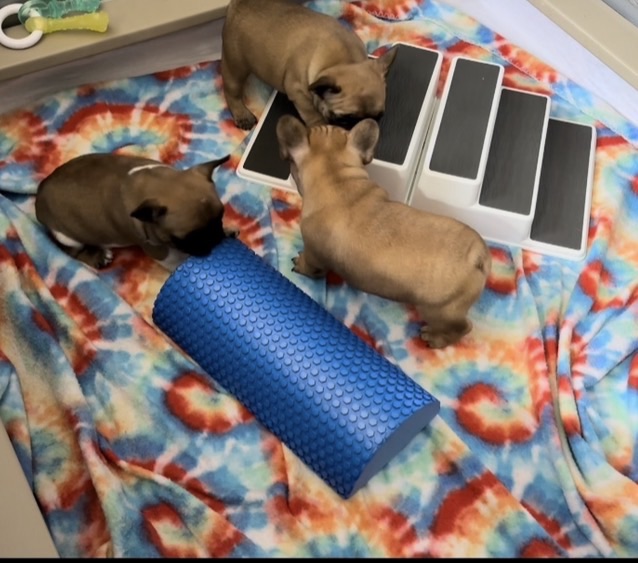
They hear the vacuum cleaner, the television, conversations, pots and pans in the kitchen, doors opening and closing, visitors coming and going, and all the normal sounds and activity of a busy household. They’re exposed to different surfaces, toys, and age-appropriate challenges as they continue through my Puppy Culture and Avidog program.
Because they’re living in the heart of my home—not isolated in a kennel—I have countless opportunities every day to observe them. I see who rushes over to investigate something new, who likes to stop and think before joining in, who naturally seeks out people, and who enjoys solving problems on their own.
Those observations happen over weeks, not minutes.
By the time my puppies are ready to go home, I don’t just know what they look like. I know who they are. That knowledge is one of the most valuable tools I have when matching each puppy with the family where I believe it will thrive.
Why I Don’t Match Puppies Too Early
Over the years, I’ve found that patience almost always leads to better decisions.
That’s why I don’t ask families to choose a specific puppy when they’re only a few weeks old, and it’s also why I don’t accept reservation fees before I’ve completed my evaluations and know which puppies will be available.
There are simply too many unknowns early on.
I don’t know if I’ll be keeping a puppy for my breeding program. I don’t know how each puppy’s structure and temperament will continue to develop. Most importantly, I don’t yet know which puppy will be the best fit for each family.
Once I’ve had the time to evaluate the litter as individuals, I begin contacting families and discussing the puppies I believe would be the best match for their home and lifestyle.
Sometimes the puppy a family initially thought they wanted turns out not to be the one I recommend. That isn’t because there’s anything wrong with that puppy. It’s because another puppy may be a better fit for their experience, activity level, family dynamics, or long-term goals.
My responsibility isn’t simply to place puppies. My responsibility is to make thoughtful, lifelong matches.
When a family brings home a TerraSassa puppy, I want them to have confidence that my recommendation is based on weeks of careful observation, experience, and getting to know each puppy as an individual.
I know waiting can be difficult, especially when you’ve been following a litter from the day they were born. But after more than four decades of raising and evaluating dogs, I’ve learned that taking the time to make the right match is worth it—for the puppy and for the family.
It’s About Building the Right Partnership
Bringing home a puppy is exciting, but it’s also the beginning of a relationship that will hopefully last 10 to 15 years or more. That’s why I believe choosing a puppy should be about much more than color, markings, or whichever puppy happened to climb into your lap during a visit.
Every puppy is an individual with its own personality, strengths, and way of interacting with the world. My job is to get to know each one of them well enough that I can confidently recommend the puppy I believe will thrive in your home.
Sometimes that recommendation is exactly the puppy you were hoping for. Sometimes it isn’t. But it is always made with one goal in mind—giving both the puppy and the family the best possible chance for a successful, lifelong relationship.
At TerraSassa, I don’t measure success by how quickly I can place a litter. I measure success by hearing from families months and years later, telling me that their puppy has become exactly the companion they had hoped for. Those updates, photos, and messages remind me why taking the time to make thoughtful matches is so important.
Every breeding is planned with care. Every puppy is raised with purpose. Every placement is made with the future in mind.
Because at the end of the day, I’m not simply placing puppies.
I’m helping create lifelong partnerships between families and the dogs they’ll love for years to come.
There Isn’t a “Perfect” Puppy
One question I hear from time to time is, “Which puppy is the best one in the litter?”
The truth is, there isn’t a “best” puppy.
There is only the puppy that is the best fit for the home it’s going to join.
Some families want a puppy that’s eager to accompany them on everyday outings and enjoys meeting new people. Others are looking for a quieter companion that’s content to spend most of its time close to its people. Some homes already have dogs, while others are welcoming their very first puppy. Some families are home most of the day, while others have busier schedules.
All of those factors matter.
That doesn’t make one puppy better than another. It simply means that every puppy has its own personality, and every home has its own dynamics.
One of the most rewarding parts of being a breeder is watching each puppy’s unique personality emerge. By the time my puppies are ready to go home, I know which one is always carrying a toy, which one likes to be in the middle of everything, which one prefers to stay close to people, and which one likes to stop and think before trying something new.
Those differences help me make thoughtful placement decisions.
When I recommend a puppy, I’m not choosing the “best” puppy. I’m recommending the puppy that I believe will have the greatest opportunity to thrive in that particular home.
After more than forty years of breeding and exhibiting dogs, I’ve learned that successful placements aren’t about luck. They’re about understanding both the puppy and the family, then bringing the two together in a way that gives everyone the best chance for a happy life together.
A Relationship Built on Trust
Choosing a breeder is about more than finding someone who has puppies available. It’s about finding someone whose philosophy and values align with your own.
When a family decides to bring home a TerraSassa puppy, they’re placing a great deal of trust in me. They trust that I’ve carefully planned the breeding, raised the puppies with purpose, and taken the time to truly know each one as an individual.
In return, I ask families to trust my recommendations.
That doesn’t mean you won’t have a voice in the process. I’ll spend time getting to know you, your home, your experience with dogs, and what you’re hoping for in a companion. The more I know about your family, the better I can help match you with the puppy that is most likely to thrive in your home.
My goal has never been to simply place puppies. My goal is to make thoughtful, lifelong matches that benefit both the puppy and the family. When I receive photos years later of a beloved companion sleeping on the couch, traveling with the family, or simply living a wonderful life, I know that taking the time to make those careful matches was worth every minute.
The Right Puppy Is Worth Waiting For
Every litter I breed represents years of planning, study, and hope for the future of the French Bulldog. Every puppy deserves to be evaluated as an individual, and every family deserves a puppy whose personality and temperament fit naturally into their home.
That’s why I don’t rush the process.
I breed for the future of my program. I evaluate each puppy carefully. Then I thoughtfully match each puppy with the family where I believe it will have the greatest opportunity to thrive.
After more than forty years of breeding and exhibiting dogs, I’ve learned that the very best matches aren’t made in a single visit or by choosing the puppy with the prettiest markings. They’re made through patience, careful observation, and a commitment to doing what’s best for both the puppy and its new family.
The right puppy isn’t simply chosen. It’s thoughtfully matched.